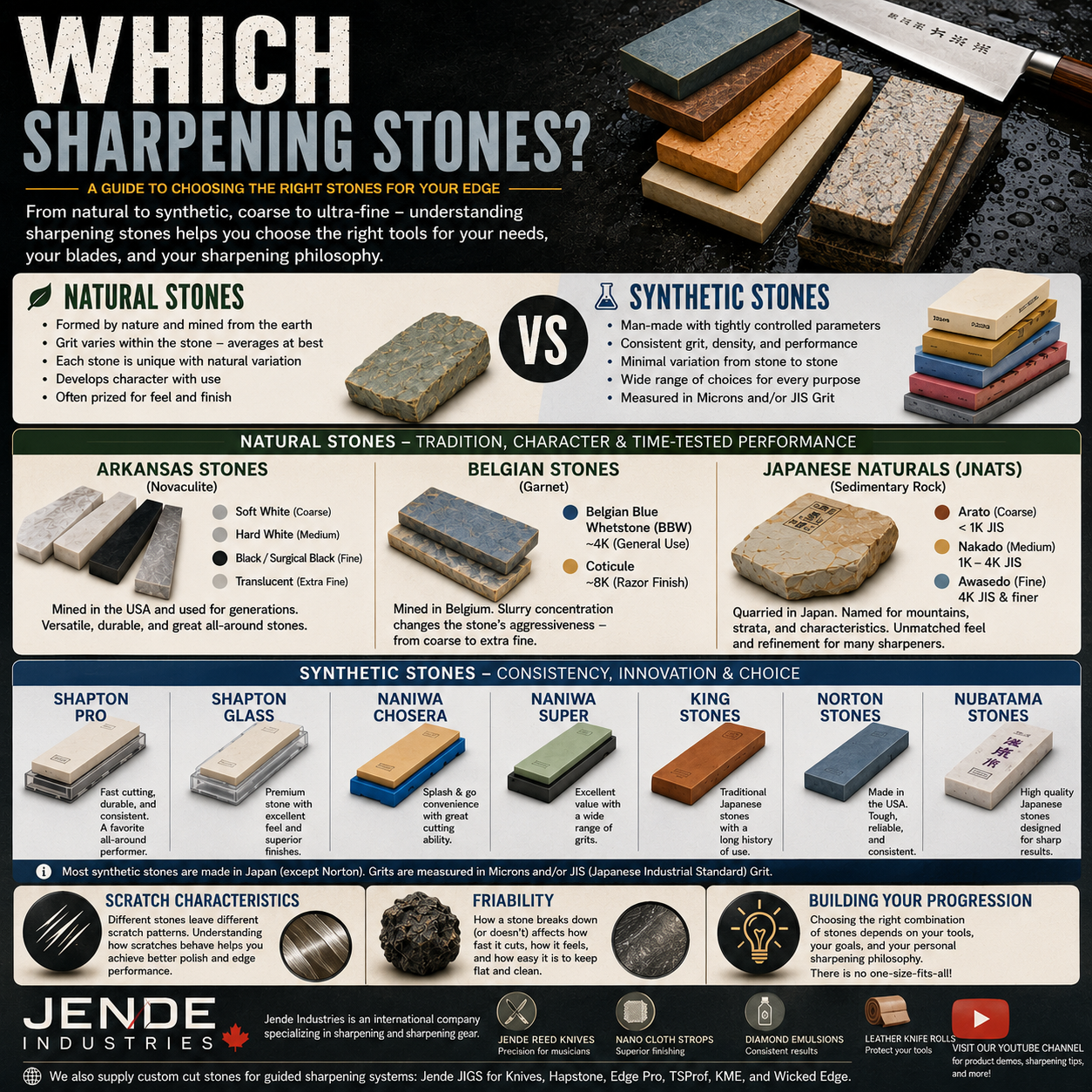
If the sharpening philosophy you embrace leads you the road of manual sharpening with stones, the inevitable question is Which sharpening stones?
As we all know, the default answer to any sharpening question is it depends; and in particular to sharpening stones, my default answer is Shapton Pros. 🙂 However, it is not that simple. This is a HUGE question, and arriving at a conclusion that suites your needs requires a lot of consideration and is almost like committing to a specific religion. With such an extensive variety of stones available on the market that are all designed to work in different capacities, knowing the basic characteristics of a stone or series of stones is the first step in the right direction. In this article I view some of the major brands from 3 different perspectives: Natural + Synthetic, Scratch Characteristics, and Friability. I then discuss my own ideas about what I consider when choosing a progression of stones.
NATURAL and SYNTHETIC
The first consideration about stones is deciding between Natural stones and Synthetic stones. Natural stones are formed through nature and are mined from the earth. Their name is usually indicative of where they are mined from, and the name also implies a certain grit range of either coarse, medium, fine or extra fine. Their overall defining characteristic is that their grit classification is, at best, an average, since their heterogeneous structures inevitably contain naturally occurring anomalies and/or inclusions throughout the stone. That is where the broad similarities end, since each stone variety is based on geological formations that have different elemental components. While it is true that “no two natural stones are alike,” I subscribe to the idea that all naturals within a given category, such as all Black Arkansas stones, are going to yield similar overall results, but within wider parameters than when compared to synthetics.
Synthetic stones are man-made stones that much more tightly control all the parameters of a given stone, which includes the abrasive itself, the size of abrasive, the density of the abrasive, the binder material (matrix which holds the abrasive), overall stone hardness, and even the color. They are most often named for their manufacturer and each series of stones follows a certain sharpening philosophy. Their grits are usually notated in Microns and/or Japanese Industrial Standard (JIS) Grit ratings (for example, 4 microns = approx. 4,000 Grit JIS). Because tight controls are available, Synthetic stones are much more homogenous than Naturals and have a very miniscule – if any – margin of variation between stones. So, for example, a 1K Shapton Pro stone manufactured 2 years ago will be the same as one manufactured today – and the risk of anomalies and/or inclusions is virtually nonexistent. While this is all good for consistency’s sake, the individual characteristics or “recipe” can infinitely, and is purposely varied, which is why there are so many different Synthetic stones on the market to choose from today.
There are many Natural stones throughout the world, but for this article, I will discuss the 3 most common Natural stone types that are widely available:
- Arkansas Stones
- Belgian Stones
- Japanese Naturals (Jnats)
For the Synthetics, there are far too many to discuss for this article, so I will limit the discussion to the more prominent stone names:
- Shapton Pro
- Shapton Glass
- Naniwa Chosera
- Naniwa Super Stones
- King Stones
- Norton Stones
- Nubatama Stones
Natural Stones
Arkansas stones are mined in the United States, and have been used for a very long time. And for a long time, Arkansas stones were pretty much the only natural stones used en mass in the US. Odds are your father or grandfather, and even great-grandfather had one of these ever-versatile stones. Arkansas stones are composed of novaculite, and are graded as soft white, hard white, black (often called surgical black), and translucent. This order is also the order of overall refinement, with soft white being the coarsest and black and translucent being the finest. You can read more details about the different Arkansas stones here.
Belgian Stones, as the name implies, are mined in the Ardene forest region of Belgium. They are composed of garnets, and come in two main grades – the Belgian Blue Whetstone (BBW) and the Coticule. The major difference between the BBW and Coticule is the concentration of the garnets, which is greater in the coticule. Traditionally, the much more abundant BBW has been used more for woodworking tools and knives while the more coveted Coticules are used for razors. They rate the BBW at 4K, and the Coticule at 8K, but that is a broad and inaccurate generalization in my opinion. The Belgian stones are interesting because their grit range/aggressiveness can be altered by producing different concentrations of slurry. So in effect, the grit range of a single stone is from coarse to extra fine. You can learn a lot more about Belgian stones, and coticules in particular, here.
While very popular, Japanese Naturals are an interesting bunch of stones because of the initially confusing and specific language used to describe them – that, and they use Japanese characters, or Kanji (砥石). There are a rather wide variety of stone names to learn and relatively few English speaking authorities on the subject, so finding rock-solid 😀 information can be daunting. However, with a good introduction, and some note taking, it becomes much easier. So this should clear things up! 😀
Most Jnats originate from mountain sides, and they often take the name of the mountain or family that historically mines them – for example, Nakayama (中山) stones are stones from “Middle Mountain”. They are mostly made up of sedimentary rock, and different strata are often part of the stone’s name. For example a Nakayama Suita (中山合砥巢板) is the stone from middle mountain, with characteristics defined as Suita. While the names of the stones do imply a certain grit range, there are 3 larger grit classifications they fit into: Arato, Nakado, and Awasedo, which literally mean “coarse stone”, “middle stone” and “fine stone”, respectively.
Coarse, Arato stones are usually rated under 1K JIS, and include stone names such as Amakusa, Hiroshima, and Ohmura. Medium, Nakado stones are roughly between 1K and 4K JIS, and include Aoto, Binsui, Ebisu, Igarashi and Tajima stones. (Incidentally, Aoto stones have their own subcategory, but for this introductory purpose we will simply classify them as medium grit stones.) Fine, Awasedo stones are approximately 4K JIS and finer, and include Hakka, Hideriyama, Izari, Nakayama, and Okudo stones. This is only a partial list, but they include the stone names that will be encountered when starting out. To find out much more about these stones, contact Ken Schwartz, who is the official North American Distributor of Tanaka Toishi, a 6th generation Japanese stone merchant
Synthetic Stones
With exception to the Norton stones, the Shapton, Naniwa, King and Nubatama stones are all made in Japan.
Arkansas stones have traditionally been used with honing oil, but I’ve heard of all kinds of lubricants being used, including water, soapy water, motor oil, WD-40, gasoline and even kerosine! I suggest picking one lubricant and sticking with it (I’d recommend the honing oil or mineral oil) Using Arkansas stones is pretty straight forward. The novaculite has a pretty hard and dense structure, so abrasion is on the less invasive side.