If you’ve been following this Sharpening Philosophy series, you have already explored the key factors that influence sharpening decisions before purchasing equipment. Developing a sharpening philosophy first can help you choose tools that match your goals and avoid investing in equipment that doesn’t fit your needs.
If this is your first article in the series, consider starting with the Sharpening Philosophy Introduction, where the main concepts are introduced.

Building Your Sharpening Philosophy
Before selecting a sharpening system, it helps to consider four main categories:
- Speed vs. Cost vs. Precision
- Mechanized vs. Manual Sharpening
- Guided vs. Freehand Sharpening
- Maintenance vs. Full Service Sharpening
This article focuses on Guided vs. Freehand Sharpening. As discussed in the previous article on mechanized and manual sharpening, either approach can be performed using guided or freehand techniques.
A Common Debate
The discussion around guided and freehand sharpening often brings strong opinions. Some sharpeners prefer guided systems, while others believe freehand sharpening is the better approach.
The reality is that there is no single answer.
The right method depends on the type of work you do, the tools you sharpen, your level of experience, and the results you want to achieve.
Understanding how each system works will help you decide which approach fits your sharpening style.
What Is Guided Sharpening?
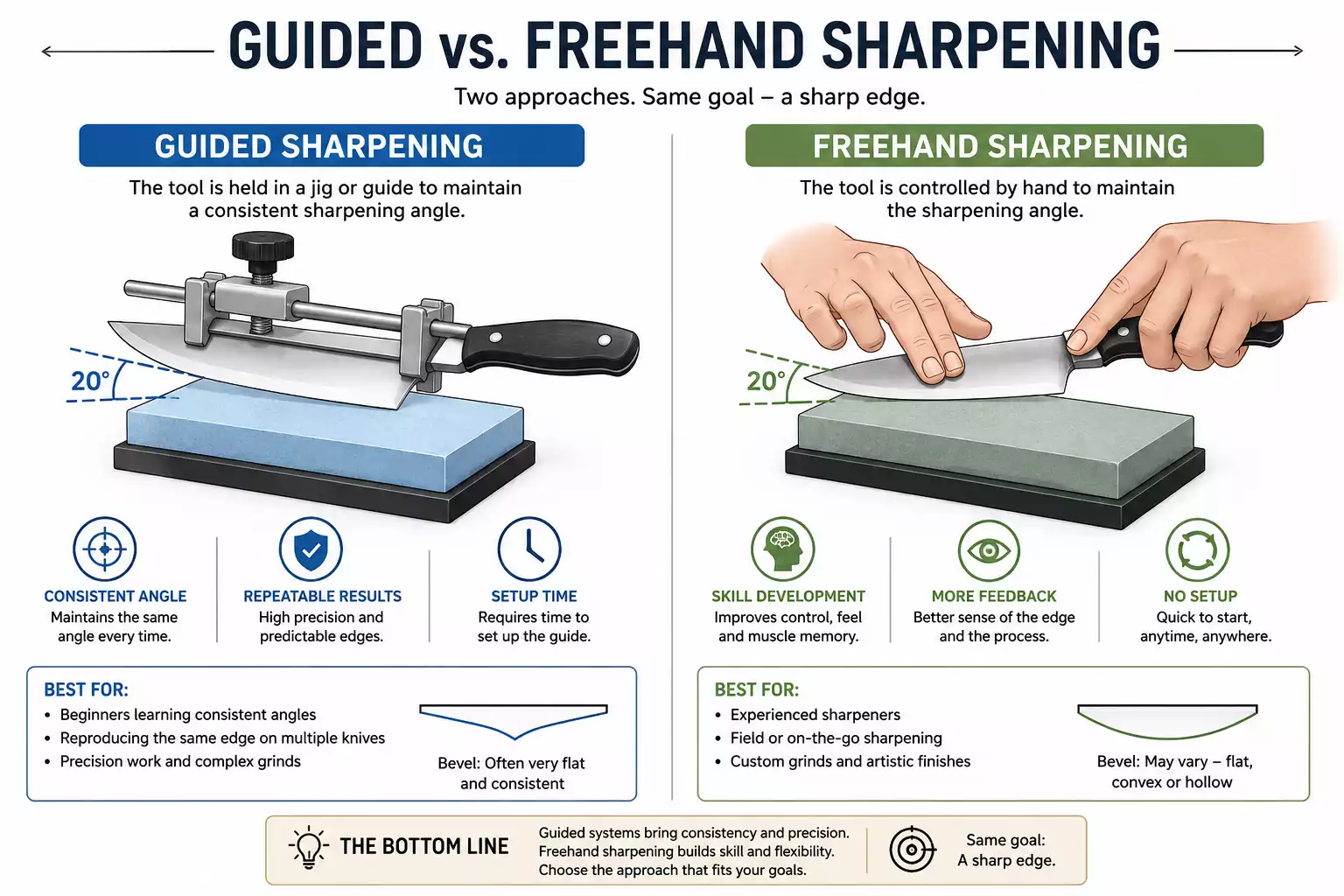
Guided sharpening uses a device that helps control the sharpening angle throughout the process.
Most guided systems secure the knife or tool in a clamp or jig while the abrasive moves across the edge. Other systems use a rod, platform, or guide bar that supports the blade while allowing the user to hold it by hand.
The purpose of every guided system is the same—to reduce variation during sharpening.
By maintaining a consistent angle, guided systems make it easier to produce repeatable results.
Why Choose Guided Sharpening?
One of the main advantages of guided sharpening is consistency.
Many sharpening mistakes occur because the sharpening angle changes during each stroke. A guide reduces this variable by helping maintain the same angle from the beginning of the process to the end.
This makes guided sharpening useful for anyone who wants repeatable bevel geometry or who sharpens several knives using the same angle.
However, there is a trade-off.
Guided Sharpening systems require additional equipment, increasing the overall cost. They also take time to set up before sharpening begins.
The level of precision also depends on the quality of the system. Higher-quality guides generally provide more consistent results than basic models.
Guided Sharpening on Mechanized Systems
Guides are also commonly used with mechanized sharpening equipment.
Some machines include simple tool rests or angle references built into the design. These provide basic support but may not offer precise angle control.
Commercial systems often include interchangeable jigs designed for specific tools. These allow the same machine to sharpen different blade styles by changing the guide or fixture.
This increases the versatility of the sharpening system without requiring major adjustments.
Bevel Geometry
Using a guide does not always produce a perfectly flat bevel.
With belt sharpeners, the knife is held at a fixed angle, but the flexibility of the belt can create a slight convex edge. The belt splice may also influence the final bevel shape.
Wheel-based sharpeners produce different results depending on the wheel material.
- Hard wheels generally create a hollow-ground bevel.
- Softer wheels tend to produce a convex bevel.
Disc sharpening systems often produce flatter bevels, although the final result depends on the abrasive surface and whether the disc rotates evenly.
Each of these bevel shapes has its own applications, and discussions comparing convex, hollow, and flat grinds continue among sharpeners.
Precision and Repeatability
Manual guided sharpening offers a high level of precision because the sharpening angle remains controlled throughout the process.
Aside from fully automated CNC equipment, few sharpening methods can match the consistency that a well-designed guided system can provide.
For users who prioritize repeatable results and controlled bevel geometry, guided sharpening remains a practical choice.
Final Thoughts
Guided sharpening is designed to reduce variables and improve consistency by helping maintain a controlled sharpening angle. While it requires additional equipment and setup time, it offers repeatable results across many types of knives and tools.
Like every aspect of sharpening, choosing between guided and freehand methods depends on your goals, your equipment, and the type of work you plan to perform. Understanding the strengths of each approach allows you to build a sharpening system that matches your own sharpening philosophy.
Amazon Link to purchase Guided Sharpening System Jende JIGS – https://www.amazon.com/dp/B0BW95VN74
One thought on “Guided vs. Freehand Sharpening: Choosing the Right Method”