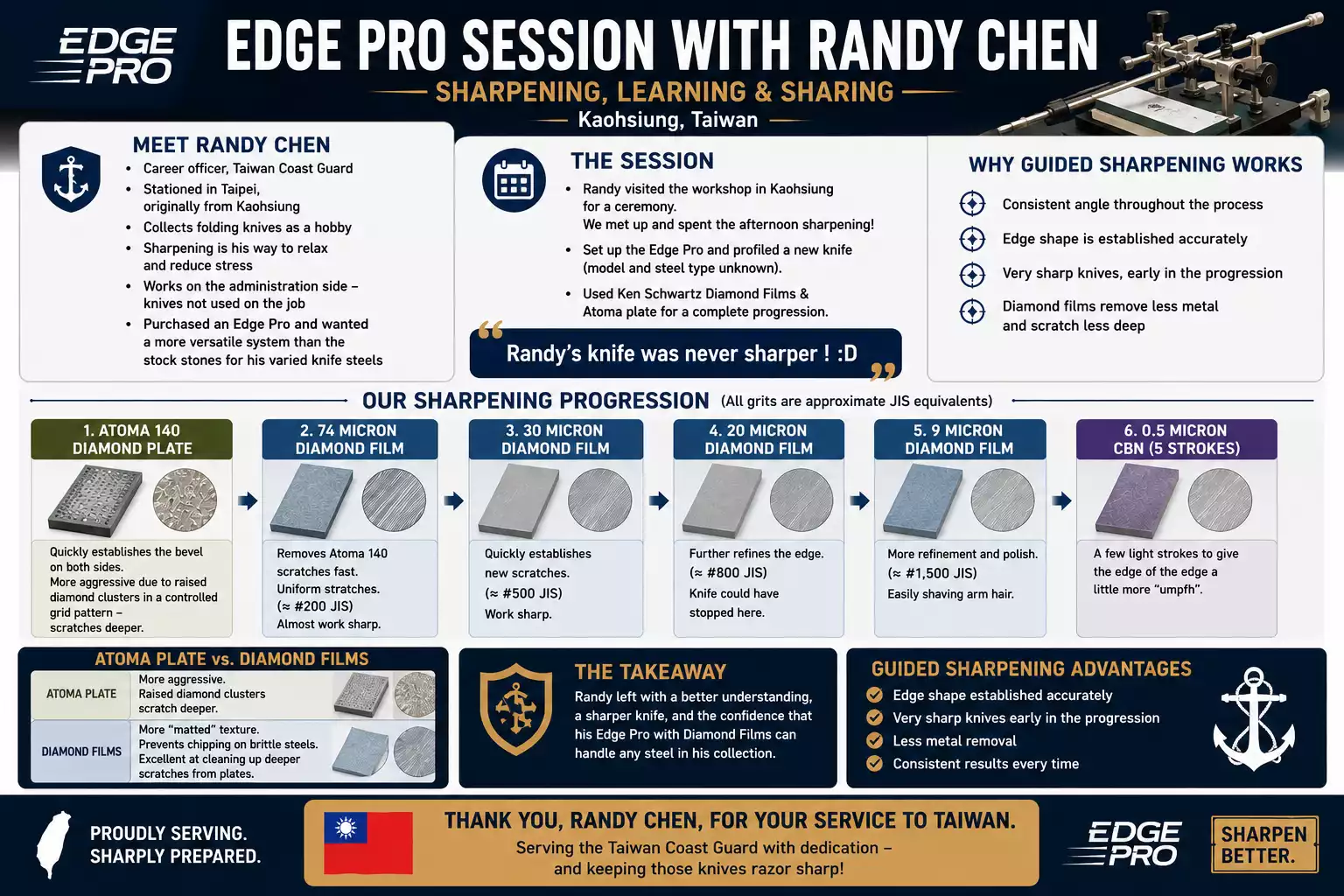
Edge Pro Sharpening Session with Randy Chen

Edge Pro users are not very common in Taiwan, so I was surprised when I received an email from Randy Chen asking about Ken Schwartz Diamond Films for the Edge Pro sharpening system.

After reading his questions, I gave him a call to discuss the products in more detail. During our conversation, I learned that Randy is a career officer with the Taiwan Coast Guard. Although he is currently stationed in Taipei, his hometown is Kaohsiung.

Since I also work in Kaohsiung, I invited Randy to visit my workshop the next time he was in the area. As it turned out, he was already planning a trip to Kaohsiung for a ceremony, and our schedules lined up perfectly. We arranged a time to meet and spend the afternoon sharpening knives with the Edge Pro system.

A Hobby That Became a Way to Relax

Randy collects folding knives as a hobby and enjoys maintaining them himself. For him, sharpening is a way to relax and reduce stress after work.

Although he serves in the Taiwan Coast Guard, his position is on the administrative side, so his personal knives are not used as part of his daily duties.

After purchasing an Edge Pro, Randy wanted a sharpening progression that could handle the different blade steels in his collection. The standard Edge Pro stones worked well, but he was interested in a system that offered greater flexibility, which led him to the Ken Schwartz Diamond Films.

Setting Up the Edge Pro

When Randy arrived at the workshop, we set up his Edge Pro and selected a new folding knife for profiling. Unfortunately, I no longer remember the knife model or the steel used for the blade, but it provided a good opportunity to demonstrate the complete sharpening progression.

We began with the Atoma 140 Diamond Plate to establish a new bevel on both sides of the knife.

I selected the Atoma 140 instead of the 125-micron or 165-micron diamond films because, although all three use diamond abrasives, the Atoma plate cuts differently.

The Atoma plate contains raised clusters of diamonds arranged in a controlled grid pattern. These raised clusters remove steel more aggressively and produce deeper scratches, making them well suited for bevel setting and profiling.

Diamond films, on the other hand, have a more uniform abrasive surface. They remove the deeper scratches left by the Atoma plate while producing a more consistent scratch pattern. Their cutting action is also useful on steels that are more prone to chipping.

Moving to Diamond Films

After completing the bevel with the Atoma 140, we switched directly to the 74-micron diamond film. Randy was surprised by how quickly the deeper Atoma scratches disappeared.

Within a short time, the knife displayed a new scratch pattern produced entirely by the 74-micron film. Although 74 microns is approximately equivalent to a #200 JIS grit, the edge was already capable of performing many everyday cutting tasks.

One of the advantages of a guided sharpening system like the Edge Pro is that the sharpening angle remains consistent throughout the process. Because the bevel geometry is established so accurately, the knife often becomes functional much earlier in the sharpening progression than many people expect.

Refining the Edge

From the 74-micron film, we moved to the 30-micron diamond film, which is approximately #500 JIS. Technically, we could have skipped directly to a finer grit, but Randy preferred to include an additional step in the progression.

The 30-micron film quickly replaced the previous scratch pattern and further refined the bevel. Next, we continued to the 20-micron film, which is approximately #800 JIS.

At this stage, the knife was already capable of handling most cutting tasks, and many users would have considered the sharpening complete.

However, we decided to continue refining the edge. Our next step was the 9-micron diamond film, approximately #1,500 JIS.

With each change in grit, Randy became more interested in how quickly the previous scratches disappeared and how the edge continued to improve. By the time we finished with the 9-micron film, the knife easily shaved arm hair, and the bevel showed a consistent scratch pattern.

A Final Finishing Step

Since we still had a few minutes remaining, we added one final step. The knife received five light strokes on a 0.5-micron CBN abrasive.

The goal was not to reshape the bevel but simply to refine the very apex of the edge before calling the progression complete.

The Result

By the end of the session, Randy’s knife was sharper than it had ever been.

More importantly, he had a better understanding of how each abrasive contributes to the sharpening process and how an Edge Pro system can be combined with diamond plates, diamond films to create a complete progression for different knife steels.

Unfortunately, our time together came to an end, and Randy had to leave for his next commitment. It was a pleasure spending the afternoon sharing sharpening techniques, and it’s always rewarding to meet another Edge Pro user in Taiwan. Hopefully, we’ll have another opportunity to sharpen a few more knives together the next time Randy returns to Kaohsiung.

3 thoughts on “Edge Pro Sharpening Session with Randy Chen

  1. Hi! Tom,

    I brought 3 knives with me that day. The one being sharpened is Bradley Mayhem, which is a bali-song of S30V Steel made in USA. The other are one folding knife of Damascus Steel and my EDC, a small California legal with the SOG brand made in Japan.

    Yes! You are right. I was really impressed by the diamond plates and films. They truly outrun all the original stone set.

    Thank your for taking your precious time to guide me to sharpen. I felt grateful when I left.

      1. Like what you said, the more you know about sharpening, the more you need to know. I couldn’t agree with you more. I’ll definitely go to see you and learn from you more. Thank you again!

Leave a Reply

This site uses Akismet to reduce spam. Learn how your comment data is processed.

Discover more from Jende Industries Blog

Subscribe now to keep reading and get access to the full archive.

Continue reading