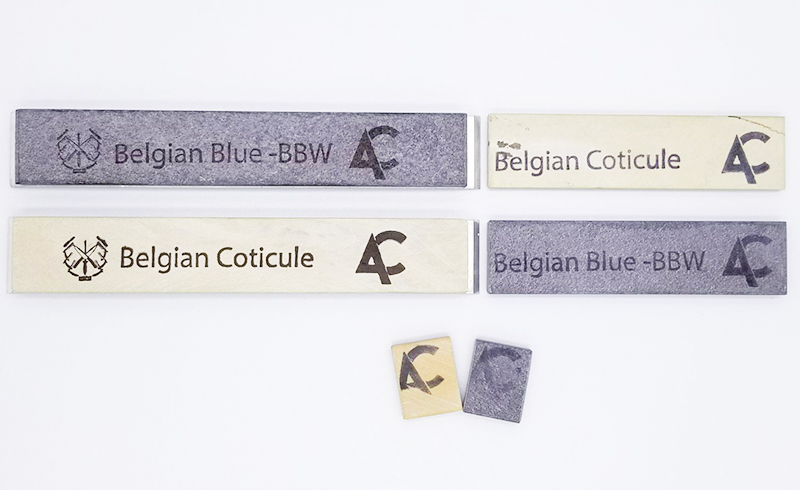
The slurry plays an important role in how both Coticule and Belgian Blue stones perform. It allows the stones to sharpen efficiently while also producing a refined edge. By adjusting the amount of slurry and water, users can move from more aggressive sharpening to finer edge refinement on the same stone, making these natural whetstones a versatile option for both sharpening and finishing.
In this video, the Belgian Coticule and Belgian Blue Whetstone (BBW) slurry stones are used by first applying a small amount of water to the surface of the sharpening stone. The slurry stone is then rubbed across the wet surface to release abrasive particles and create a sharpening slurry.
The appearance of the slurry differs between the two stones. On a Belgian Blue Whetstone, the slurry develops a milky purple color, while a Belgian Coticule produces a milky white slurry. Continued rubbing creates a thicker slurry, which increases the stone’s cutting action during sharpening.
As sharpening progresses, the slurry will gradually darken as it collects metal particles from the blade. Once the edge has been established, the need for aggressive cutting decreases. Water can then be added gradually to dilute the slurry, reducing its cutting action and allowing the stone to work at a finer level. This progression from thick slurry to clean water helps maximize the sharpening and finishing capabilities of both Belgian Coticule and Belgian Blue Whetstones.
The Coticule and Belgian Blue Whetstone stone and Slurry stones can be found at Jende Industries, or on the direct links below:
1×4 KME Size Belgian Coticule
1×4 KME Size Belgian Blue Whetstone
1×6 Edge Pro, Hapstone and TSProf Size Belgian Coticule
1×6 Edge Pro, Hapstone and TSProf Size Belgian Blue Whetstone