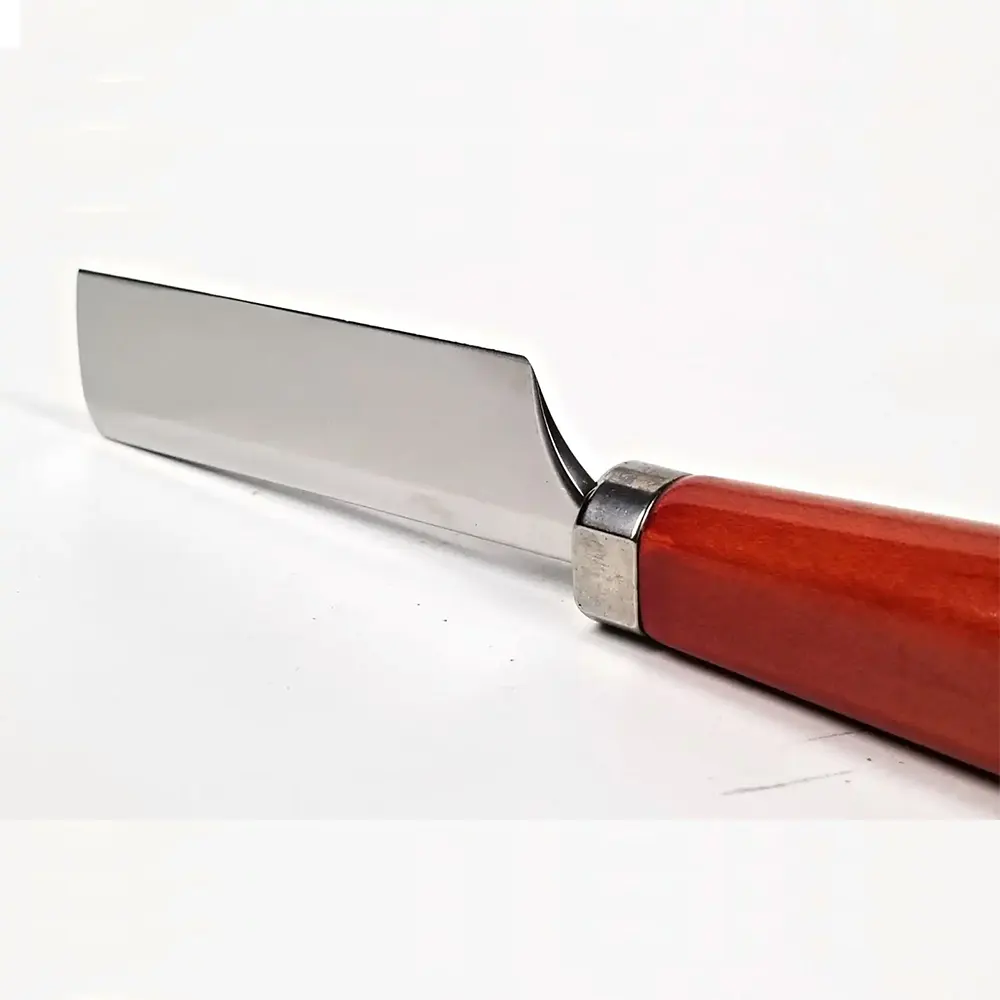
I was getting ready to tackle my first straight razor restoration after winning several vintage razors on eBay. Over the previous few days, I had spent quite a bit of time reading restoration discussions on the Straight Razor Place (SRP) forums to better understand the process before getting started.
Most of the razors I received had some degree of surface rust, while a handful had already developed small areas of pitting. My objective was to restore the blades to a clean, polished condition while preserving as much of the original steel as possible. That proved more difficult than it sounds. Vintage straight razors often have extremely thin blades, so using a high-speed buffer or flap wheel can quickly become risky. Too much heat can build up, and an aggressive wheel can remove far more metal than intended. On the other hand, doing the entire restoration by hand with wet-and-dry abrasive paper would take an enormous amount of time.
Then, one morning on my way to work, I had a thought that made me realize how familiar this problem actually was.
It took me back about seven years, to when I first started working with reed knives. At the time, sharpening wasn’t part of my plan at all. I intended to operate simply as a distributor and sell the knives I received from the manufacturer.
When the first shipment arrived, however, I discovered that every blade had been covered with a protective layer of polyurethane to prevent corrosion during storage and transportation.
I didn’t want that coating left on the finished knives, so I began experimenting with different ways to remove it while also giving the blades a clean, polished appearance. After testing several approaches, I eventually found that small slip stones worked surprisingly well. I could polish each blade by hand and achieve the smooth appearance I was after.
There was just one major problem: it was incredibly slow.
Each knife took almost three hours to polish completely. After working through nearly a hundred knives, I realized that the method simply couldn’t support a growing business. The results were excellent, but the amount of time and labor involved made the process impractical.
Still, I wouldn’t consider those early experiments wasted effort. They taught me a great deal about abrasives, polishing, steel, and the amount of material that different techniques remove. More importantly, the experience pushed me to look for a process that could deliver similar results without consuming hours of labor.
Eventually, I discovered the advantage of using a buffing wheel. It could produce a polished appearance in a fraction of the time required by hand polishing. The original scratches from manufacturing didn’t completely disappear, but instead of remaining rough and exposed, they became smooth and polished. That was enough to significantly improve the surface and help prevent further corrosion.
What previously required several hours of careful handwork could now be accomplished in seconds.
That discovery completely changed the way I approached polishing. But, as I would eventually realize, it also set me on a path toward something much bigger—and that’s the part of the story I really want to share.
This is where failing forward comes into play. First, in my quest for knowledge on polishing blades, I ultimately got into sharpening because all of the information available was for polishing, as in sharpening. The failure of hand polishing the blades with slip stones lead me to make the market’s sharpest reed knives, to me becoming something of an authority on sharpening reed knives, and to me actually writing a reed knife sharpening book (with plans for a DVD in the works as well…).
But here’s the kicker. As I was thinking about how I would be polishing up the old straight razor blades, the idea of using the slip stones came into my mind. Here’s the full circle – 8 years ago, I spent a plethora of time trying to polish the reed knife blades using the slip stones – developing a technique that was uneconomical. It was abandoned for 7 years – until today.
So for my first razor restore job, I will already have the skills, and a considerable amount of experience to polish up a rusty blade.
So every failure is a success in waiting, even if it takes 7 years (or more) to reveal itself!