Most people think of a strop as the final step after sharpening a way to polish the edge and remove the last traces of a burr. But we were curious about something else. Could a diamond-loaded strop actually reduce a small chip in the edge of a knife?
To find out, we put it to the test.
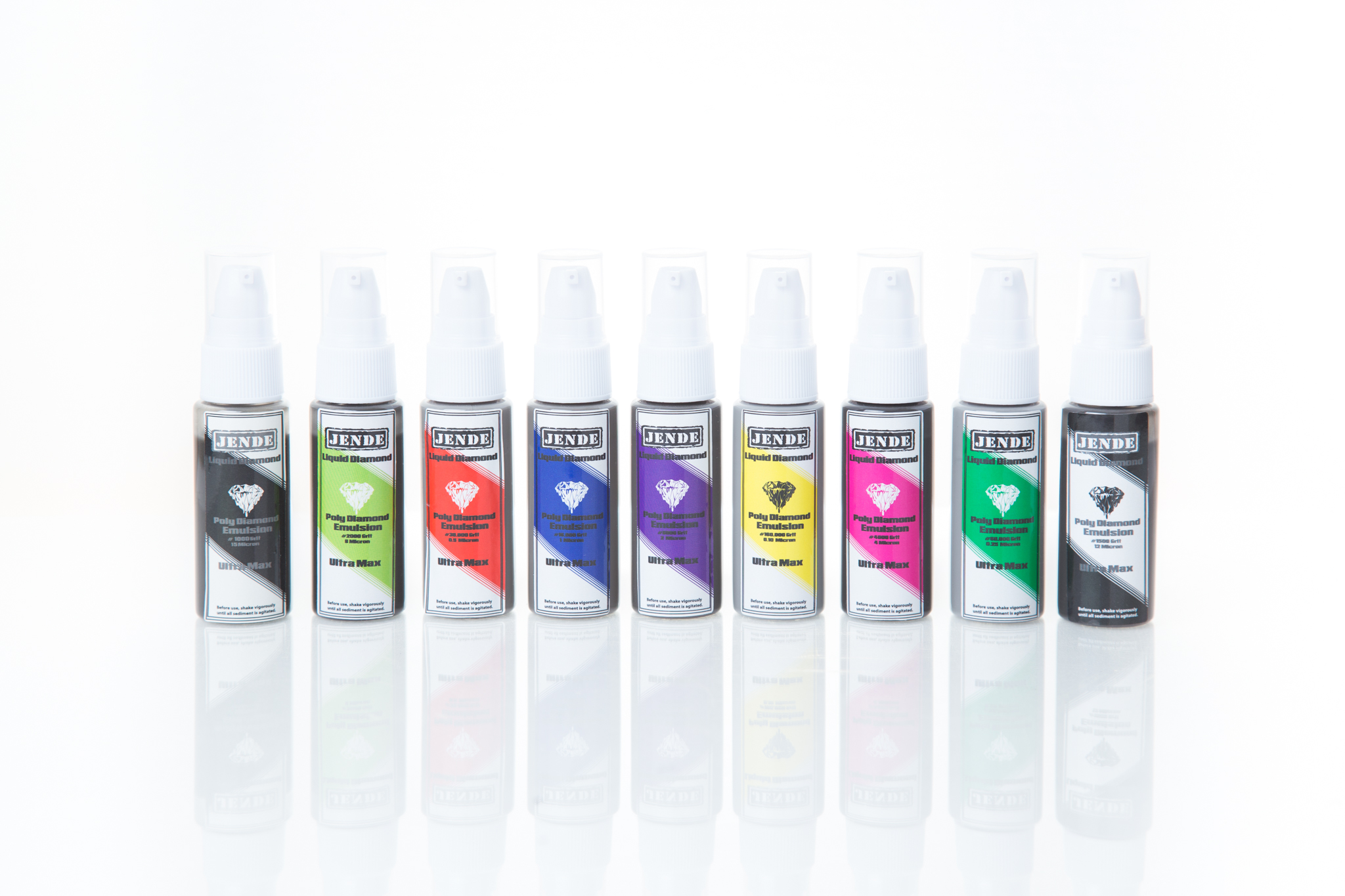
A Jende Nanocloth Ultra Strop was loaded with Jende 12 Micron Max Concentration Poly Diamond Emulsion and used on a blade made from 52-100 steel. Rather than judging the results by eye, we photographed the edge under a microscope every 20 strokes to see exactly what was happening.
The chip wasn’t large, but it was easy to identify under magnification. As the stropping continued, the shape of the damaged area slowly began to change. By the end of the test, after 200 strokes, the chip had been reduced by approximately 0.010 mm (0.0004″). While measurements at this scale can never be considered perfectly exact, the microscope images clearly showed that the top portion of the chip had worn away over time.
Another interesting observation was the finish of the bevel itself. As the chip became smaller, the surrounding bevel also became noticeably cleaner and more polished. The diamond emulsion wasn’t only affecting the damaged area it was refining the entire edge.
Does this mean stropping can replace sharpening? Not at all. If a blade has a significant chip, sharpening on stones is still the proper solution. However, this test demonstrates that a diamond-loaded strop is capable of removing a small amount of steel. Given enough passes, it can gradually improve tiny imperfections while simultaneously polishing the edge.
It’s a good reminder that stropping isn’t just for the final shine. With the right abrasive, it also performs real cutting work just at a much slower and more controlled rate than a sharpening stone.
Sometimes the smallest changes are the easiest to miss, which is why a microscope can tell a very different story than what the naked eye sees. In this case, it showed that even after hundreds of light stropping passes, measurable changes were taking place where it mattered most: right at the edge.