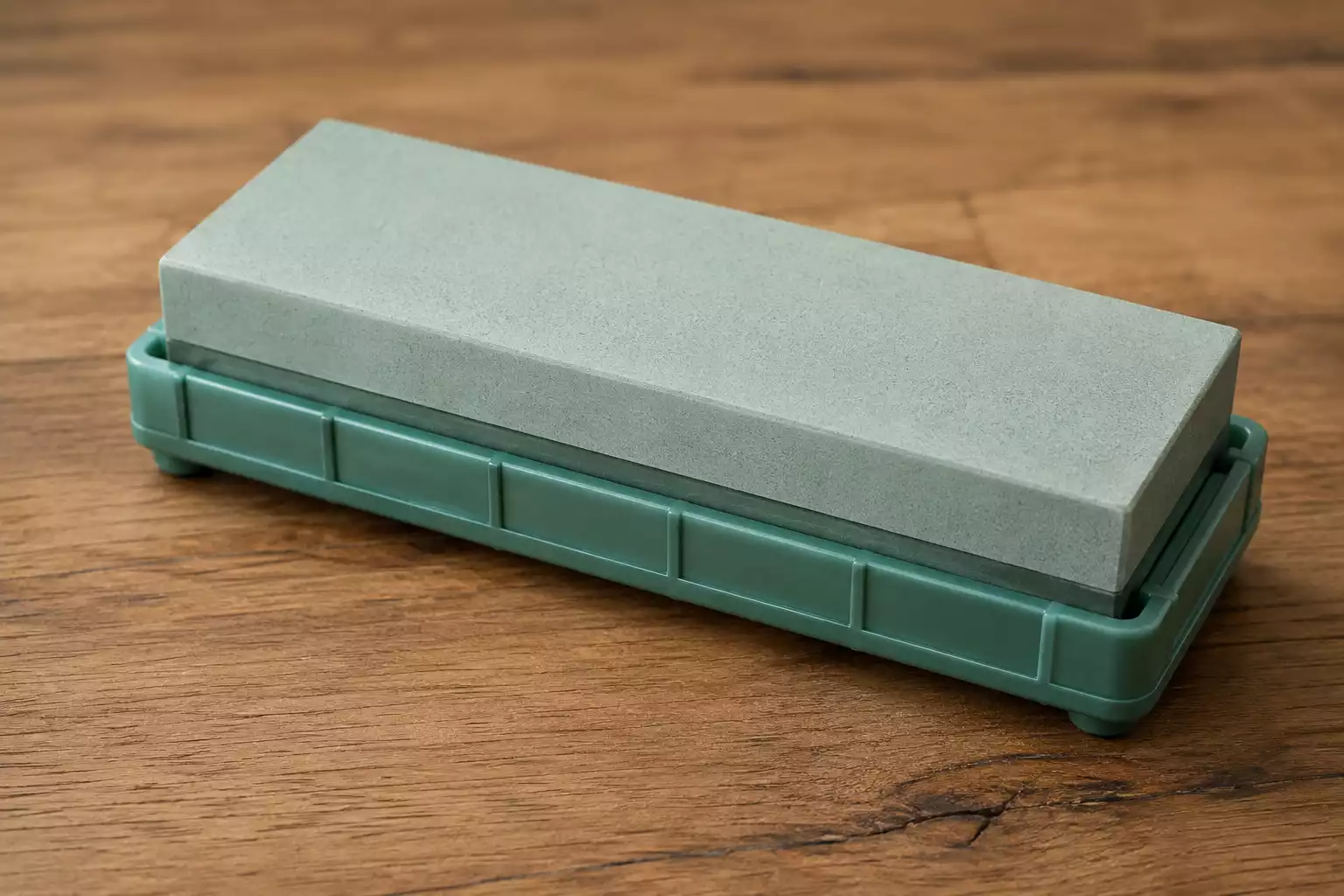
For a long time, I considered the Shapton Professional Stones to be the best choice for almost any sharpening situation. There was one notable exception: Lie-Nielsen D-2 Cold Hardened plane blades, for which the Shapton Glass series was specifically designed.
Recently, however, I’ve started to change my mind particularly when it comes to straight razors.
Why I Started Looking at the Glass Series
For about three months, I’ve been thinking about how the different characteristics of the Shapton Professional and Glass Stones might affect straight-razor sharpening.
My original theory was fairly simple. The Shapton Professional Stones are harder and maintain their shape longer. Because of this, I expected them to produce a straighter, more precise bevel on a straight razor.
The Shapton Glass Stones, being softer, seemed more likely to wear slightly during sharpening. My assumption was that this could potentially produce a slightly rounded or convex bevel.
At first, that made the Professional Stones seem like the obvious choice. But after working with them more, I’m not so sure.
The Glass Stone Theory
It now appears that the softer Glass Stones may actually have an advantage when sharpening straight razors.
The key isn’t simply how quickly the stone wears. It’s how the stone and the razor edge interact with each other during sharpening.
A straight razor doesn’t necessarily have a perfectly flat bevel. There can be a slight amount of roundness to the bevel, particularly as the razor is sharpened and the geometry of the edge develops.
The Glass Stones seem to accommodate that slight roundness more readily. Because the Glass Stones are softer and more consistent in their behavior throughout the series, each successive grit can conform to the existing bevel relatively quickly. This means fewer strokes may be necessary to get the next stone working effectively on the edge.
The Difference in How They Work
One way to think about the difference is With the Glass series, the stone conforms to the edge. While with the Professional series, The edge conforms to the stone. That difference may sound subtle, but when you’re sharpening a straight razor with very little pressure, it can become significant.
The Professional Stones maintain their shape extremely well. That’s an advantage in many sharpening applications. But when you’re using almost no pressure on a straight razor, wearing down a Professional Stone enough for it to conform to a slightly rounded bevel can take quite a few strokes.
This may also explain something that some users have experienced with the higher-grit Shapton Professional Stones: they sometimes seem to require considerably more strokes than expected.
At the higher grits, especially, you’re not putting much pressure on the razor. Consequently, the stone isn’t wearing very quickly, and the bevel may need to do more of the conforming.
So Which Is Better for Straight Razors?
This is where my thinking has changed. The characteristics that make the Shapton Professional Stones excellent for maintaining a flat, consistent sharpening surface may not necessarily make them the ideal choice for every straight-razor application.
The Shapton Glass Stones appear to have an interesting advantage: their softer and more consistent nature allows the stones to adapt to the bevel more readily.
That can make the sharpening process faster and potentially more consistent from one grit to the next. Of course, there are exceptions, and I wouldn’t claim that the Glass series is automatically better for every straight razor or every sharpening technique.
But based on this new information, my opinion has definitely shifted. So, armed with all of this, which Shapton series do you think is better for straight razors?
Useful Link – https://jendeindustries.com/
Think before you answer… : )
I am not sure your suspisions are correct. I can’t prove this though, because I don’t have a set of professional stones to test against the glass. I can, however, tell you what my experience with the glass are.
While honing over a hundred razors with the shaptons, I have not experienced a rounding of the edge. In fact, I can produce the bevel, which I consider to be two parts – the one you see and the edge you don’t – on a 500k shapton and literally cut arm hair. This is a good indication that there is no round edge.
The glass stones also seem to require fewer strokes once you leave the 4k stone, well as compared to naniwas which to me are problematic at best.
I personally find the Shapton glass stones to be superior to any other synthetic stones I have used, but then I haven’t tried the pro line either.
This is just my own personal opinion however
Yeah, this was written when I was still in the early stages of figuring out razor sharpening. My suspicions were based on the way I was sharpening at the time, which was with waaaaaaayyy too much pressure! Even now, I am just getting the pressure right, IMO.
I must agree that I like my Glass Stones for the razors. My favorite are the 3K Glass and the 10K Glass, which along with a few others that I have, are not yet available in the US. 🙂
My progression lately is either the 1K, 2K or 3K, followed by the 4K, 20 or so strokes on the 8K, then strop and test, then proceed to 5-6 strokes on the 10K, and between 3 and 5 strokes on the 30K. Strop on my Kanayama 50,000 – I always lose count, it’s so enjoyable… :), then enjoy the BBS shave!
I’ve revisited the Naniwas several times, both the Super Stones and the Choseras. I will admit that the Choseras are much nicer to use than the SS, but I find the Naniwa edges to be a bit “toothy,” a comment that many knife users use in a positive light.
I’ll have to update my suspicions! Thanks for reading!