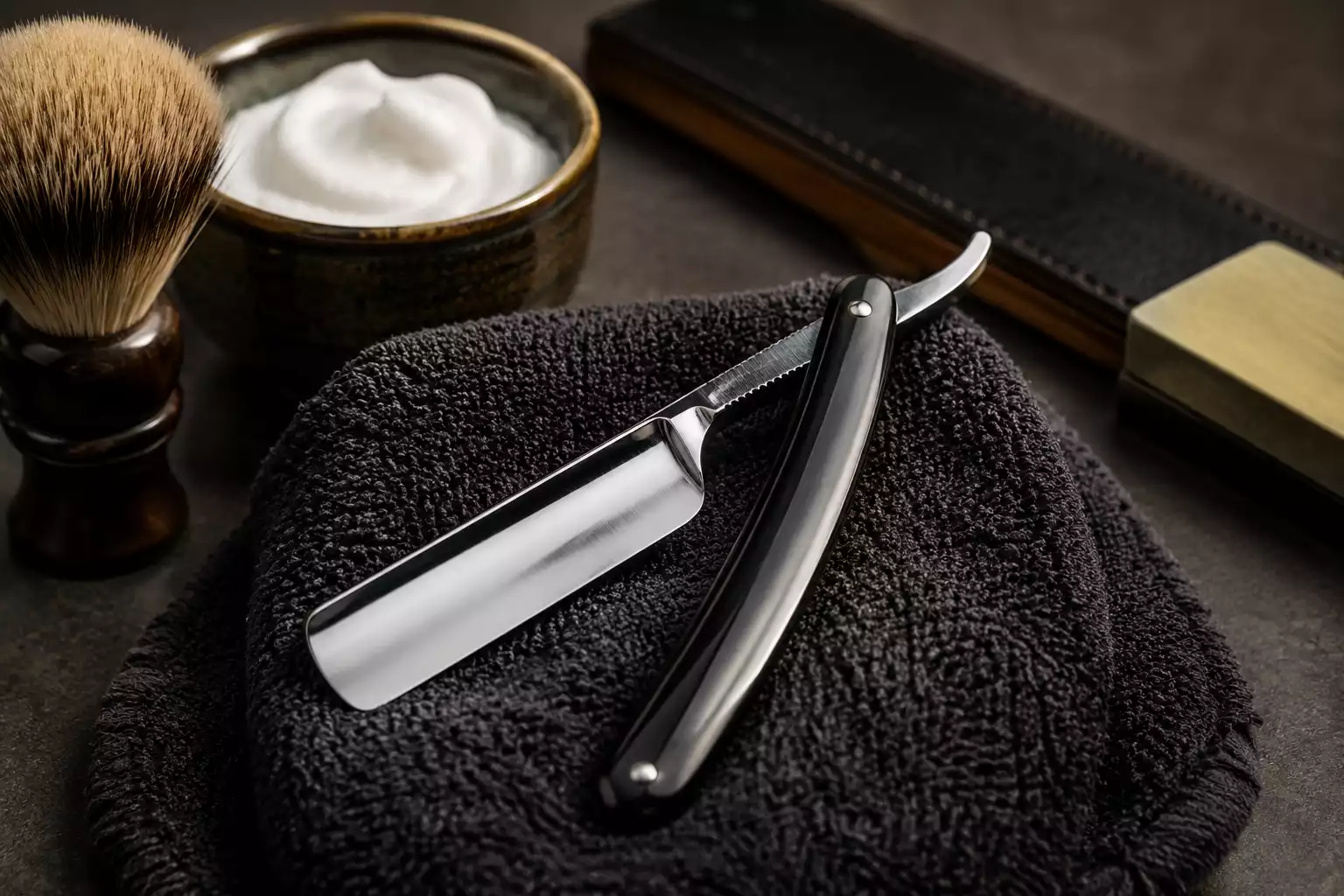
Trying someone else’s straight razor can be a great way to learn how different blades, grinds, and edges perform. After using my exchange partner’s Boker straight razor, honed on a Japanese Nakayama stone, I found the experience both fun and interesting.
First Shave: Smooth and Comfortable
The first shave was surprisingly smooth. Compared with my TI or Bismark razors, the Boker felt much lighter in the hand. Its thin hollow grind also produced a different sound while shaving, but these characteristics did not negatively affect its performance.
I was initially a little cautious because it was my first time using the razor. I wanted to understand how the blade handled before becoming more aggressive with my technique. Even so, I was able to complete my usual WTG (with the grain) and ATG (against the grain) passes and achieve a BBS (baby smooth) result.
Overall, I thought the razor had received a very good honing job.
Second Shave: A Little Stropping
For the second shave, the razor needed a little stropping. I decided not to use any sharpening stones because I knew that bringing out one stone would probably lead to bringing out all of them and wanting to resharpen the entire razor.
The strop was enough to keep the edge going and allowed me to finish the shave comfortably.
This time, I felt much more comfortable with the Boker. I had already become familiar with its lighter weight and balance, so the razor moved around my face more naturally.
There was a slight difference in the edge compared with the first shave, but I did not consider this a problem with the honing work.
How Good Was the Boker’s Edge?
My overall conclusion was simple: the owner of the Boker did a very good job honing the razor.
At the same time, judging a straight razor edge is highly subjective. What we feel during a shave can be influenced by the razor’s grind, weight, balance, our expectations, shaving technique, and the sharpening itself.
The Boker seemed to have a different type of edge compared with my own razors. My razor has a sharper feeling on the skin and continues scraping during later passes, even when there is little hair left to remove.
The Boker seemed to know when to stop. Even when I could still feel some hair with my fingers, the razor did not continue scraping the skin as aggressively.
This is not necessarily a negative characteristic. In fact, it could be a very useful quality for someone who shaves regularly.
The “Corporate Shave”
This difference made me think of what I would call a “Corporate Shave.”
I could easily imagine this Boker being used every day or every other day by someone who wants a clean, comfortable, and smooth-enough shave for work.
The razor’s relatively thin hollow grind and light weight made it very easy to maneuver around the face. It quickly became comfortable to use, and the edge provided a pleasant shaving experience without feeling unnecessarily aggressive.
I also wondered whether the edge could benefit from additional refinement. That does not necessarily mean using higher-grit stones. It could simply mean spending more time working the edge with additional passes during honing.
Why You Should Try Other Straight Razors
One of the most interesting parts of traditional straight razor shaving is discovering how different razors can feel.
Two razors can both be properly sharpened and still provide completely different experiences. Weight, balance, blade thickness, grind, honing technique, and edge refinement can all influence the shave.
Because so much of the experience is subjective, I think every straight razor enthusiast should try other people’s razors when given the opportunity—with permission, of course.
Trying different razors can help you better understand your own preferences and appreciate how much variety exists in traditional wet shaving.
Overall, the Boker provided two enjoyable shaves, and the honing work was clearly very good. It was a fun reminder that sometimes the best way to understand straight razor edges is simply to experience something different.