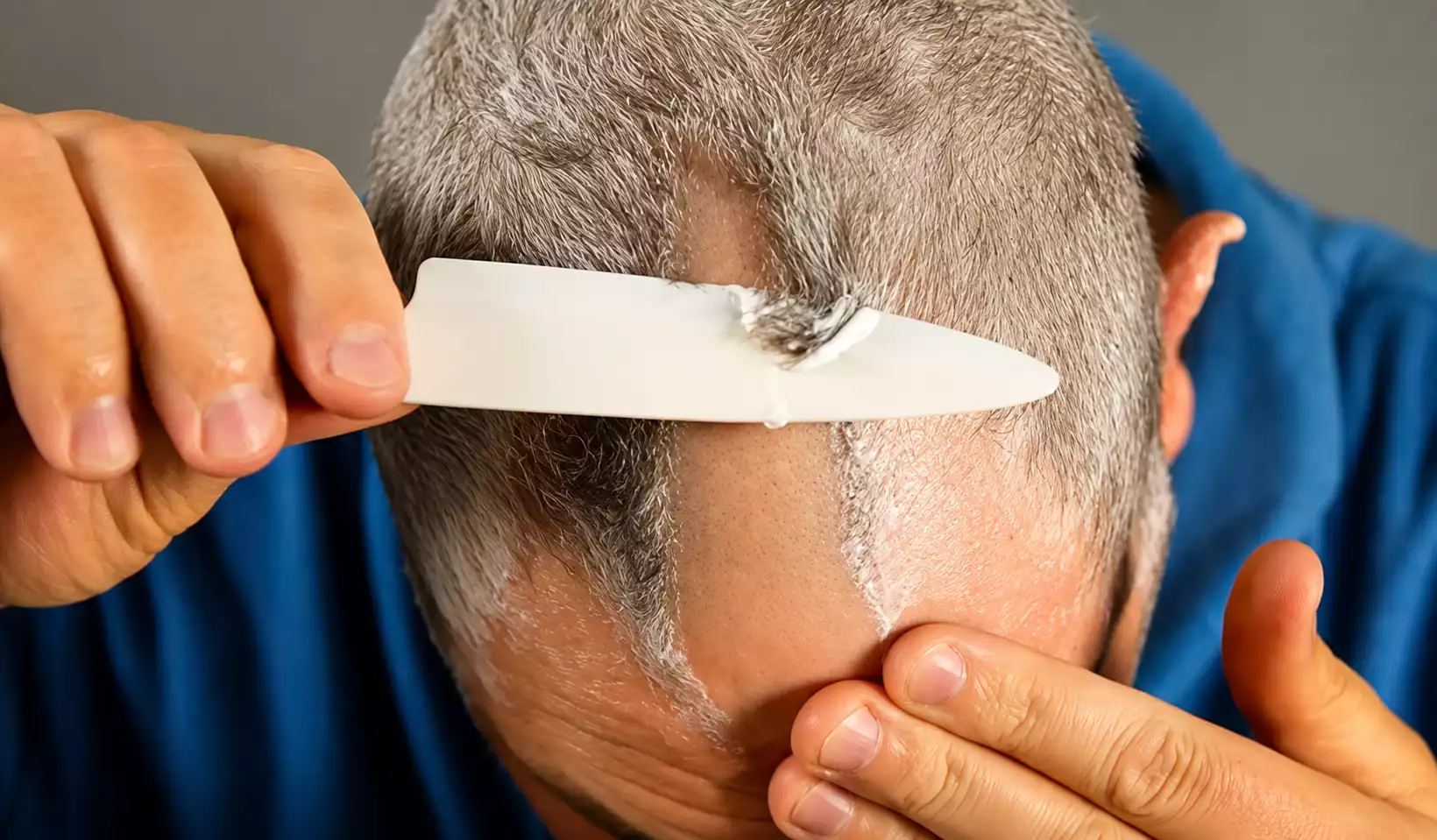
Ever Since Jens won the shaving competition by shaving his head with a chisel, everyone pretty much accepted the fact that whatever came next would take second place to his pure originality and genius/madness.
Until now. (video is below)
I stumbled on the ceramic knife as a razor quite by accident. As an experiment, I was sharpening a Kyocera ceramic paring knife as a reed knife when I noticed that the edge was getting sharp enough to actually cut some hair after using Ken Schwartz’s diamond paper at 6 microns. I immediately went to the store and bought another Kyocera Ceramic Knife – but the smallest they had was the utility knife, which was a little longer than the paring knife. No problem for me, though, since I’ve shaved with 10″ knives and big cleavers 😀
The factory edge off the ceramic knife is actually quite impressive – it’s sharper than a lot of other knives right out of the box, but it does require a sawing motion to be most effective. I’d rate the factory edge at about 2K, or 8 micron. The edge angles were a little steeper than I wanted since ceramics don’t have much give like steel knives, and they will chip out due to their ultra-hardness if the angles are too low. But for a straight razor knife, the rigidness of the ceramic blade could be combined with lower angles since the edge wouldn’t fold or roll like thin steel at lower angles.
Ken’s diamond papers come in in several sizes and span a huge range of grits (from 165 micron to 0.1 micron, or approx. 100 grit to 150,000 grit). For this project, I used his 3″x8″ diamond films on glass. I started with the 74 micron (~200 grit) diamond paper to establish the lower bevel angles. Since this was being done freehand, I would guess about 10-15 degrees per side is where I was aiming. As hard as ceramics knives are, I was quite amazed just how easy it was for the diamond films to abrade the knife. It was just like using a conventional sharpening stone on a piece of steel – I was using both forward and backward strokes (as opposed to single sided strokes) – and many of the same characteristics of sharpening steel still came into play, even though the most obvious feature that was left out was the lack of burr formation. The 75 micron was almost a little too aggressive, but it made quick work of the profiling. Then I went through the grits step by step – 45 micron, 30 micron, 20 micron, and 15 micron (320 grit, 500 grit, 800 grit, and 1K, respectively). It was a bit overkill since the diamonds really did perform, but I was still on a learning curve, so it was safer not to skip. I also did enough strokes to make VERY sure I had reached the edge of the edge since there were no real indicators of sharpness. I monitored the sharpness under my microscope (no pictures on this one, I was in too much a rush!)
Hehehe! Very funny video! 🙂