It’s funny how often my thoughts seem to drift back to straight razors.
At the moment, I’m waiting for a razor exchange with another member of the Straight Razor Place (SRP) community. I sent him my Thiers-Issard, finished on the 30K Shapton Glass Stone, and in return he’ll be sending me one of his razors. Before shipping them, we agreed on one important rule: both razors had to arrive shave ready. That way, we could evaluate each other’s work based on actual shaving performance rather than just appearance.
Preparing my razor was simple. Since it had already been fully sharpened, all it needed was a few light finishing strokes on the 30K Shapton Glass Stone before packing it up.
My exchange partner follows a different approach. He sharpens using natural Japanese stones and finishes every razor with a leather strop. What really interests me is trying a razor that has been completed entirely on natural stones. I’ve heard plenty about their performance, but this will be my first opportunity to experience one firsthand.
The conversation also got me thinking about how much sharpening technology has changed.
Today, synthetic sharpening stones make it relatively easy to achieve extremely refined edges. Reaching 8,000 grit, 16,000 grit, or even 30,000 grit is simply a matter of choosing the right stones. High-quality synthetic stones are widely available, making these levels of refinement accessible to almost anyone interested in learning the process.
That raises an interesting question.
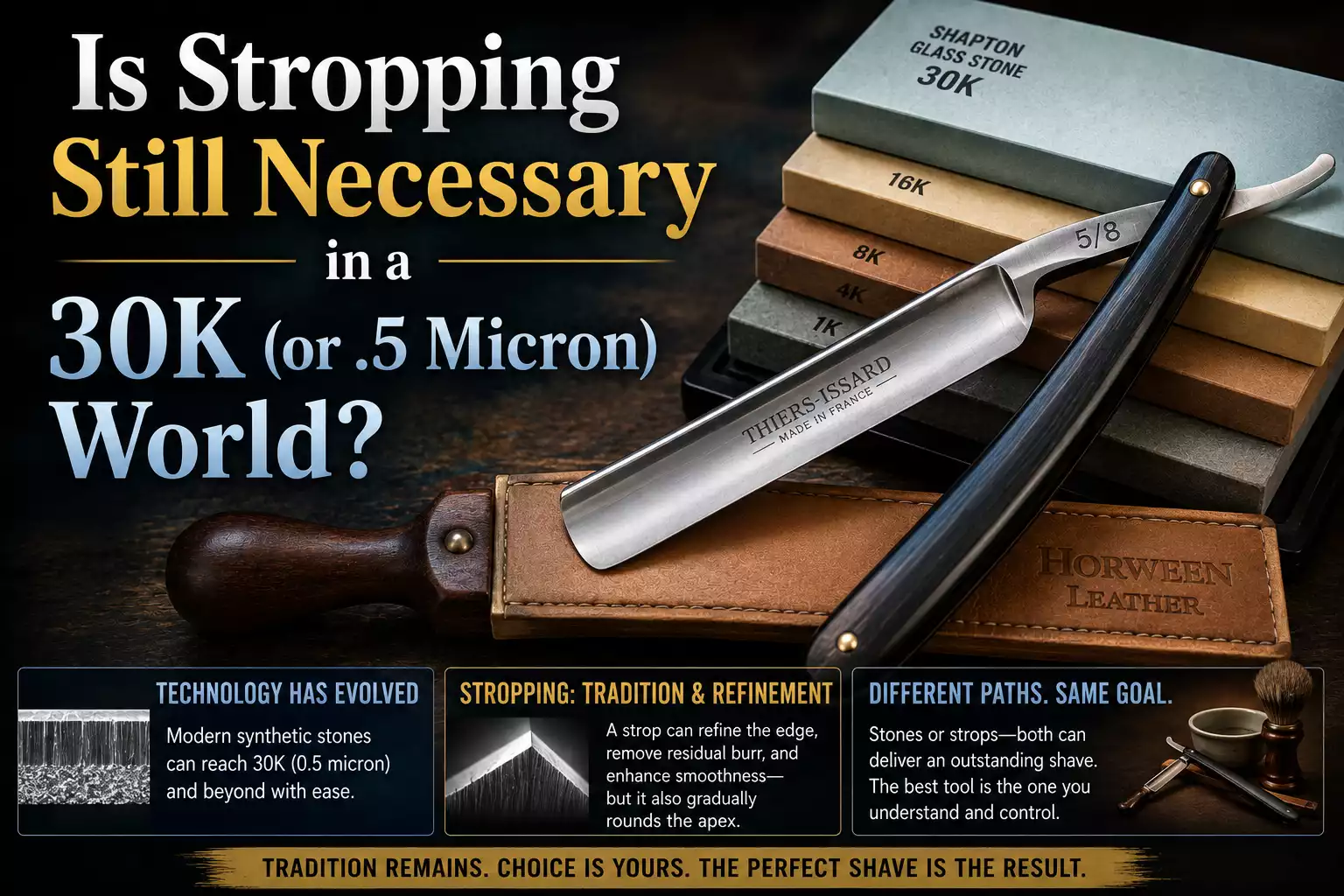
If a razor has already been finished on a 30K stone, or roughly 0.5 micron, is stropping still necessary?
Personally, I’ve often wondered about that.
Historically, stropping served an important purpose. Years ago, most sharpeners worked with stones such as Arkansas or India stones, along with barber hones that simply couldn’t produce the level of refinement available today. A leather strop helped clean the edge, remove the remaining burr, and gradually improve the shaving performance between full sharpening sessions.
Modern synthetic stones have changed that landscape considerably.
With today’s polishing stones capable of producing highly refined edges, it’s reasonable to ask whether a strop still adds enough improvement to justify the extra step. In some cases, repeated stropping can even begin rounding the very apex of the edge over time. Initially, that slight convexing may improve the shave, but excessive stropping eventually changes the geometry of the edge.
Of course, stropping isn’t limited to plain leather anymore.
Many sharpeners now use leather, balsa, nanocloth, or other stropping materials loaded with chromium oxide, diamond compounds. Some of these compounds are available in abrasive sizes as fine as 0.25 micron, or approximately 60,000 grit. When used as part of a complete progression, these compounds can further refine an already polished edge.
On the other hand, if stropping becomes the primary sharpening method, the edge will eventually need to be reset on a flat sharpening stone. A strop refines an edge, but it doesn’t permanently replace the role of a sharpening stone.
Perhaps the answer isn’t simply about performance.
Leather strops have been part of straight razor shaving for generations, and that tradition continues today. Even though synthetic stones have advanced dramatically over the past few decades, stropping remains part of the routine for many straight razor users. Whether that’s because of measurable improvements, personal preference, or simply tradition is an interesting question—and one I’m looking forward to exploring once my exchange razor arrives.
Useful link – https://jendeindustries.com/product/straight-razor-honing-services/
Hi Tom,
My observations under 100x magnification supports your idea on stropping would only insult the edge. Even adding pasted strops make no sense. Also, if done properly the 30000 grit is giving you a very clean geometry as you are forming a very true, clean edge. BTW, nice blog. These 30000 edges seem to hold up better too.
Mike
Thanks Mike! I think the randomness of the pastes and layout of the abrasives on the strop vs. the relative uniformity of synthetic hones is what makes that difference. Something more to think about!! 🙂
Tom,
Certainly “more to think about”. Especialy if you consider that the surface of strops, linen etc are by nature ful of small undulations in contrast with a well prepard hone. Even films with microabrasives on PSA might give more than the surface of a hone. The down side for average Joe, of course, is the harder the stone the more skill required. (This is why I believe we got “stuck” on razors.)
On your thoughts on “why the razor” As life has brought you to the razor world from other areas of sharpening like myself from the world of Luthierie. Razors are one of the few tools man has come up with that has a built in honing guide,i.e. the spine. It is a tool that lends itself well to what the honing medium is doing verses the plethura of sharpening techniques and jigs required for other edges. You can isolate much better the variables and relate it better to the outcome. Many razor users will come around eventually to this idea IMHO because so many of them are suffering from HAD. If they admit it or not, they know that a better edge is just around the corner and no other tool is suited to this as much as a razor.
Mike
Mike,
I might just turn this comment into a post! I’ve been thinking about the consistency of the leather vs. that of a .5 micron Shapton 30K. It is skin, and if you look at our own skin, the shape and depth of the grooves will influence the power of a strop – I think strop makers have had plenty of history to notice that, thus the best leather, ironically, is from the posterior end. I haven’t seen my own close enough to comment on its ridge structure, though!
With more thinking, the ridges seem to lend themselves to actually helping retain the oils and natural abrasives in them, therefore making the patterns not much unlike the somewhat chance arrangement of abrasive particles in the stones…..
Speaking of “Posterior”
I have often thought about my life’s journey in tool sharpening. Carb stones, arkansas, india then some synthetic Japanese stones. That was a turning point for me. Shapton’s latest line is of Glass stones with grits up to 30K was a game changer.
In the past, the strop would only come out to just a get what could not be done with a stone. Now to have complete control of the final shape of the bevel all the way to .5 microns breaks the paradigm. Strops will always have a place in sharpening, but there is another choice, the Shapton 30K. In and of itself, I believe it is the greatest achievement in sharpening technologie of recent time. Fast, clean controlled edges that push the honer and the honee(tool) to it’s practical physical limits.