Learning to sharpen takes practice, but having the right reference books can make the process much easier. Over the years, I found several books that helped me better understand not only how to sharpen, but also why different methods and abrasives produce different results.
This list focuses on books that explain the principles of sharpening, edge formation, abrasives, metallurgy, and sharpening equipment. While there are many excellent books and videos dedicated to specific tools—such as chisels, woodworking tools, or reed knives—the resources below provide a broader understanding of sharpening as a whole.
If you have another book that deserves a place on this list, feel free to recommend it. Including the author, ISBN, and a brief explanation of why it is useful will make it easier for others to find.
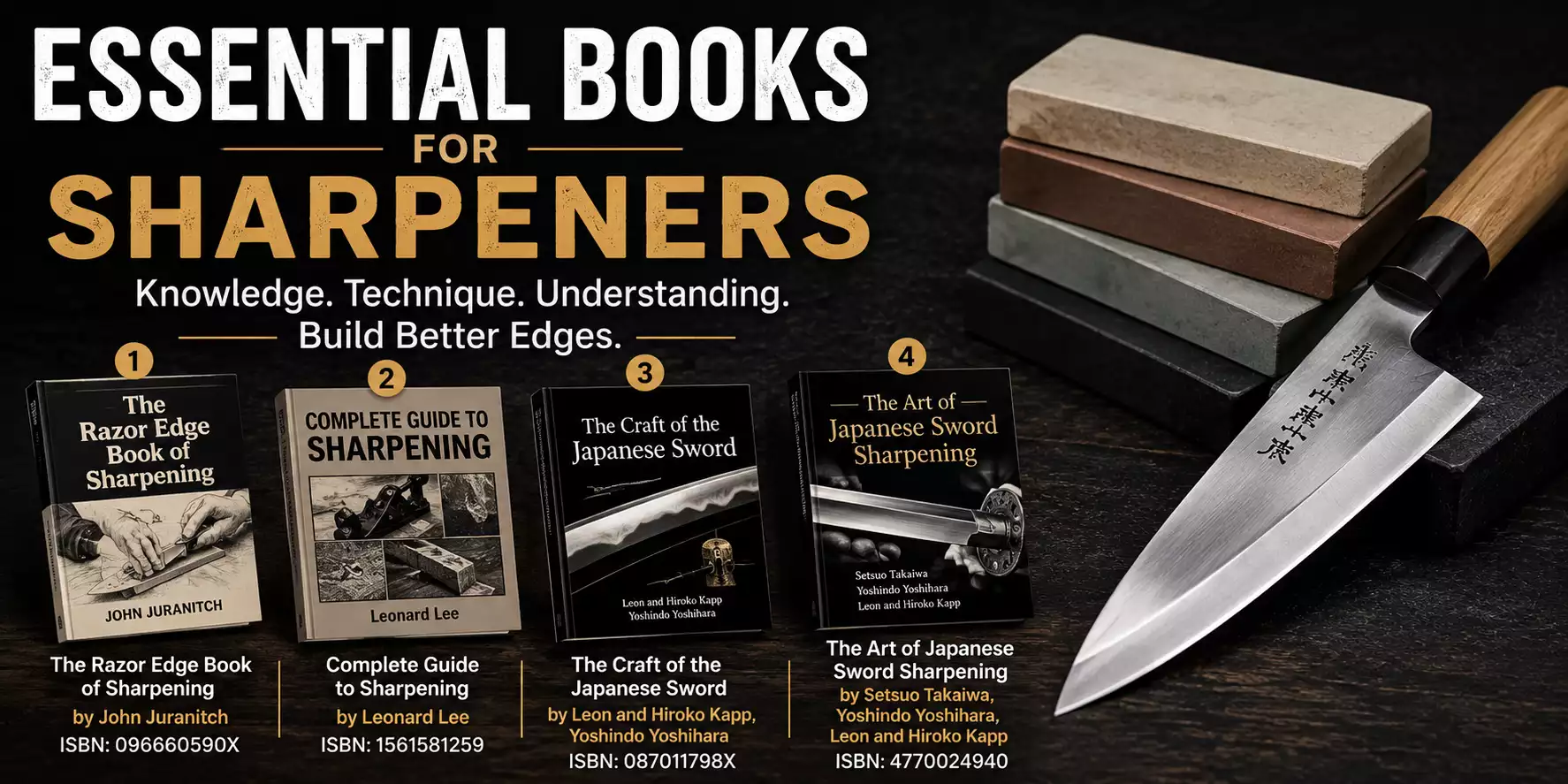
1. The Razor Edge Book of Sharpening
Author: John Juranitch
ISBN: 096660590X
This is one of the best books for anyone beginning their sharpening journey. The writing is straightforward, making the concepts easy to understand even if you’ve never sharpened before.
The book is divided into two sections. The first explains the fundamentals of sharpening, answers common questions about knives, and introduces both freehand and guided sharpening methods. The second section expands into sharpening a variety of outdoor and workshop tools, including folding knives, axes, plane irons, chainsaws, scissors, fishhooks, arrowheads, skinning knives, and several other cutting tools.
The book includes numerous black-and-white photographs and illustrations that help explain the techniques being discussed.
2. Complete Guide to Sharpening
Author: Leonard Lee
ISBN: 1561581259
Anyone who wants to study sharpening in greater depth should consider reading this book.
Rather than focusing only on sharpening techniques, Leonard Lee explains the science behind sharp edges. The opening chapters cover topics such as sharpness, cutting mechanics, metallurgy, abrasive materials, and sharpening equipment, providing readers with a solid understanding of why different sharpening methods work.
The remainder of the book concentrates primarily on woodworking tools, although it also includes information on knife sharpening.
One of the most valuable features is the collection of microscope photographs comparing edges produced by different sharpening stones. The appendices are also worth reading, particularly the grit comparison chart, which helps explain the relationship between different grit standards.
3. The Craft of the Japanese Sword
Authors: Leon Kapp, Hiroko Kapp, and Yoshindo Yoshihara
ISBN: 087011798X
Although this book focuses on the construction of traditional Japanese swords, it contains valuable information for anyone interested in sharpening.
One chapter follows the polishing process, showing how each stage changes the surface of the blade and how the scratch pattern progresses from one stone to the next. Studying this process provides a deeper appreciation of edge refinement and surface finishing.
The book also explores Japanese sword construction, steel preparation, lamination methods, and the different craftsmen involved in producing a finished sword. Numerous diagrams and photographs help illustrate each step.
4. The Art of Japanese Sword Sharpening
Authors: Setsuo Takaiwa, Yoshindo Yoshihara, Leon Kapp, and Hiroko Kapp
ISBN: 4770024940
This book continues where The Craft of the Japanese Sword leaves off, focusing entirely on the polishing of a single Japanese sword from beginning to end.
Readers are introduced to the anatomy of the sword, traditional polishing techniques, sharpening stones, modern materials, and the history of Japanese sword polishing. The book also profiles several well-known polishers and explains the methods they use throughout the polishing process.
While most people will never polish a Japanese sword in this manner, many of the concepts can be applied to other forms of sharpening. The attention given to each stage demonstrates how careful progression and consistency influence the final result.
The book contains many close-up photographs that clearly document the polishing process and help readers understand how refinement develops with each step.
5. The Jende Book of Sharpening Double Hollow Ground Reed Knives
Author: B. Thomas Blodgett
Published by: Jende Industries, LLC
The Jende Book of Sharpening Double Hollow Ground Reed Knives is a practical guide for anyone who wants to learn how to sharpen double hollow ground reed knives. Written for both beginners and experienced reed makers, the book explains not only the sharpening process but also the principles behind it, making it a useful reference for oboe and bassoon players alike.
One of the book’s main contributions is the Nickel-Dime Sharpening Method, a sharpening technique developed and used by Jende Industries for sharpening hollow ground reed knives. The method is presented in a step-by-step format that allows readers to build confidence while developing consistent sharpening results.
The first half of the book focuses on sharpening theory, covering concepts such as edge geometry, bevel formation, troubleshooting, and sharpening techniques. The second half applies those concepts through detailed instructions that guide readers through the complete sharpening process.
Designed as if the reader were attending one of B. Thomas Blodgett’s sharpening demonstrations, the book uses clear explanations supported by more than 70 full-color photographs, illustrated definitions, and a glossary of common sharpening terms. It also includes instructions for both right-handed and left-handed users, making the guide accessible to a wider audience.
Available in English and Spanish, this book serves as both a learning resource and a long-term reference for anyone maintaining double hollow ground reed knives. Whether you’re sharpening your first reed knife or looking to improve your technique, it provides a structured approach that emphasizes understanding the sharpening process rather than simply following a set of steps.
Final Thoughts
Every sharpener develops their own approach over time, but these books provide a strong foundation for understanding the principles behind sharpening. Together, they cover practical techniques, metallurgy, abrasives, edge geometry, polishing, and the relationship between sharpening and cutting performance.
Whether you’re maintaining kitchen knives, woodworking tools, straight razors, or collecting Japanese swords, these resources offer knowledge that extends well beyond simply putting an edge on a blade. They help explain why sharpening works, making it easier to improve both your technique and your results.