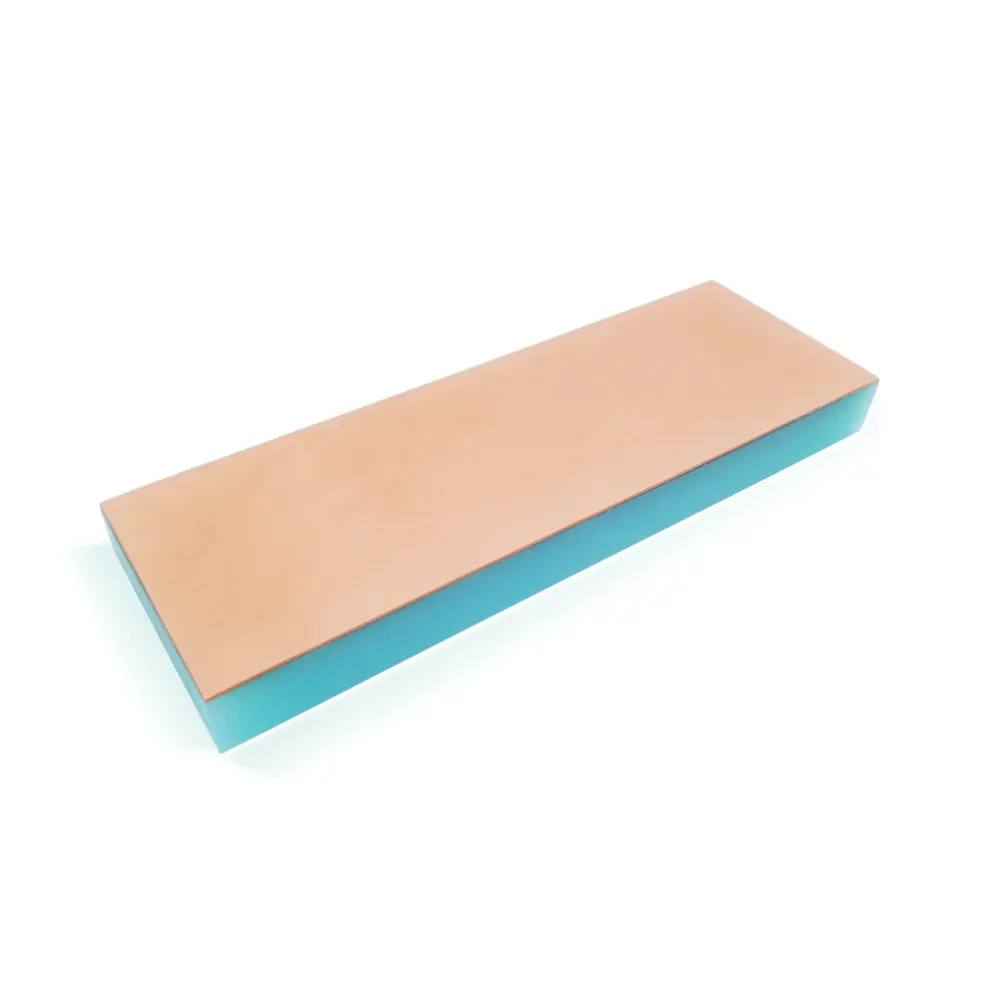
We’ve recently introduced the Jende Kangaroo and Leather strops on color coded acrylic to our lineup. One of the questions that will inevitably be asked is “which one is better?” As usual, the answer is “it depends”. They are both excellent mediums, and this article is designed to allow you to make a better informed decision about which is better for you and your particular needs.

Kangaroo and Cow leathers are both tanned animal skins, In this case it is vegetable tanned, which is basically untreated with any oils, waxes, etc.. It’s the most natural foundation which can then be used as a clean, final strop or be loaded with pastes, sprays, compounds or emulsions of your choosing. Cow leather has a much longer history of use for stropping, with Kangaroo leather only becoming more accessible since Crocodile Dundee first appeared in the 1980s. 😀

Ounce for ounce, kangaroo has about 10 times the tensile strength as cow leather, meaning a thin 1mm strip of kangaroo is about as strong as a 2-3mm strip of cow leather. This translates into less compression of the kangaroo strop over the cow strop, which can be advantageous in certain situations like straight razor honing. But the compression of the cow leather can be more suitable to matching the shape of convex edges.
In order to better describe more of the differences between kangaroo and cow leather, we need to look more closely under the microscope. Here’s a side by side macro view of the Jende cow and kangaroo leathers. Pictures are taken with a Veho 400x and the actual resolution is 1.3mm wide x 1mm high.


At this level, the cow leather looks very consistent and smooth. There is what’s best described as a “spotted” texture to the leather, but it seems flat, overall. (It reminds me of the surface of painted drywall, actually.) The Roo, however, looks like an army of ants are embedded in the surface. These are the hair follicles of the skin. Overall, the surface looks smooth, even with the contrast of the black follicles. Honestly, there’s not much difference to be seen between the two skins here.
Where things really change are at the micro level. This resolution is 1mm wide by 0.75mm high.


Choosing the right stropping leather can make a noticeable difference in the final performance of your edge. While both cow leather and kangaroo leather are excellent stropping materials, they behave quite differently because of their natural surface characteristics. Understanding these differences can help you select the strop that best matches your sharpening goals.
The Surface Makes the Difference
When viewed under magnification, cow leather and kangaroo leather reveal two very different textures.
Cow leather has a relatively smooth surface with slightly raised, polyp-like structures. These raised areas are the first points to contact the blade during stropping. Kangaroo leather, on the other hand, has a smoother overall surface with small natural depressions where the hair follicles once were. Rather than protruding, these tiny divots sit below the main surface.
Although the differences appear subtle, they have a significant impact on how each strop interacts with the edge.
Cow Leather: More Bite and Faster Action
Because the raised portions of cow leather make the initial contact with the blade, the stropping action tends to feel slightly more aggressive. When an abrasive compound is applied, those raised areas can concentrate more pressure on the edge, creating deeper polishing scratches while removing material efficiently.
This characteristic makes cow leather an excellent choice for:
- Routine edge maintenance
- Touching up working knives
- Restoring slightly rolled edges
- Sharpening outdoor and hunting knives
The result is a fast, responsive stropping surface that delivers excellent cutting performance while maintaining a practical working edge.
Kangaroo Leather: Smooth and Consistent Refinement
Kangaroo leather offers a different experience. Its surface provides more uniform contact across the blade, allowing the abrasive to work evenly from heel to tip. Once loaded with a polishing compound, the tiny surface depressions become filled, creating a remarkably consistent stropping surface.
Rather than producing deeper scratches, kangaroo leather creates a finer, more even scratch pattern. Although it may seem less aggressive at first glance, the increased contact area means more of the edge is being refined during every stroke. The material removes steel in a more controlled and consistent manner, making it ideal for highly refined edges.
Which Strop Should You Choose?
The answer depends entirely on the type of edge you’re maintaining.
For example, a hunting knife finished around 2,000 grit often benefits from a cow leather strop. The firmer, more aggressive contact helps realign the edge while maintaining the toothy characteristics that work well for field use. When paired with a 4-micron Jende Diamond Emulsion, cow leather produces an excellent balance between refinement and cutting aggression.
Straight razors and ultra-fine kitchen knives tell a different story. Their delicate edges benefit from the consistency of kangaroo leather, which helps maintain perfect edge alignment while reducing the risk of uneven wear or micro-chipping. Loaded with a 0.25-micron or 0.10-micron Jende Diamond Emulsion, kangaroo leather produces an exceptionally smooth, highly polished edge with a remarkably uniform scratch pattern.
If your priority is speed, stronger edge correction, and a more aggressive stropping action, cow leather is an outstanding choice. If you’re chasing maximum refinement, mirror finishes, and ultimate consistency, kangaroo leather is difficult to beat.
Many experienced sharpeners keep both on hand, using cow leather for working edges and kangaroo leather for fine finishing. By understanding how each material interacts with the blade, you can build a stropping progression that perfectly matches your knives, your sharpening style, and the level of refinement you’re looking to achieve.