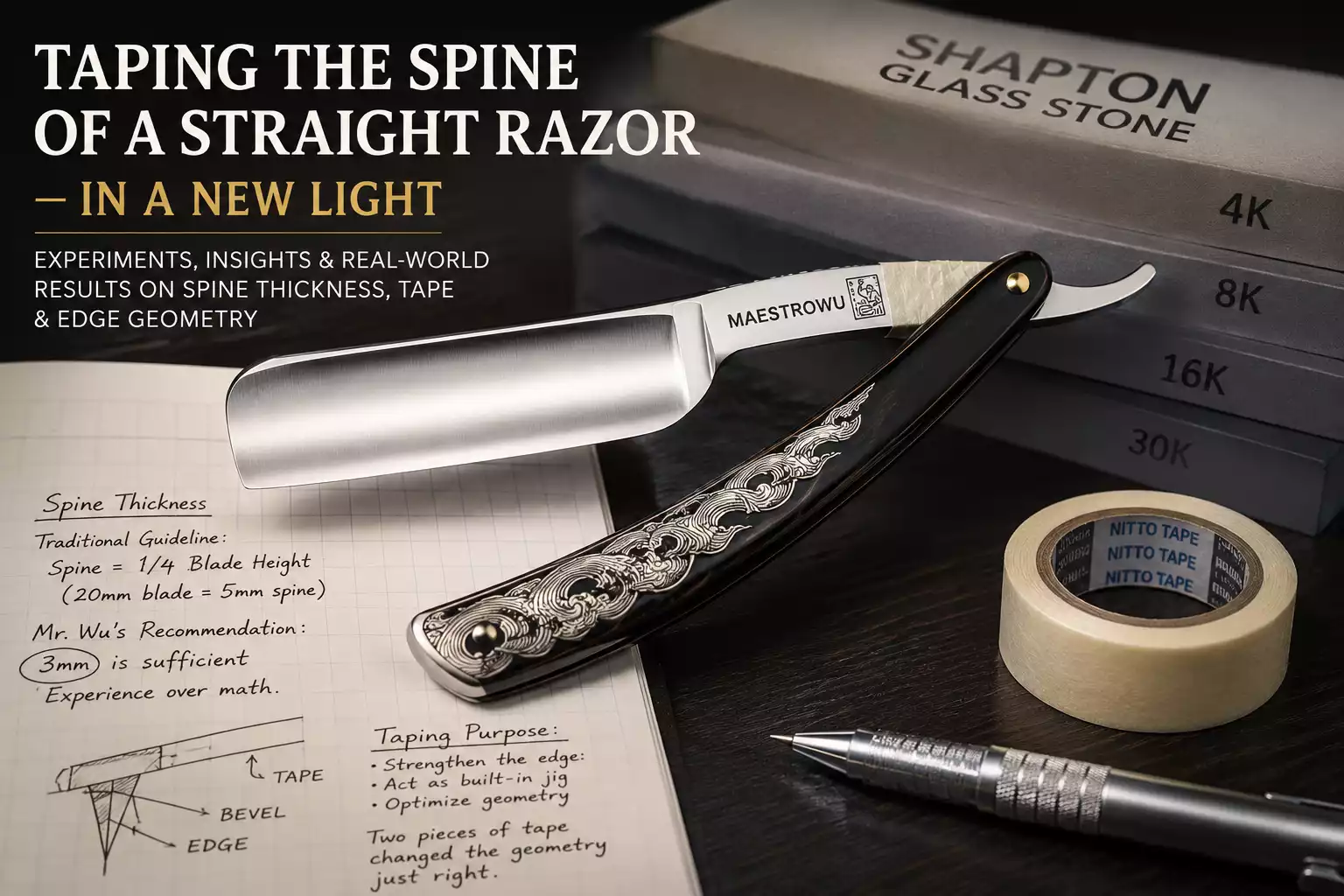
I recently visited one of my to discuss the possibility of making a Japanese-style straight razor for a member of the Straight Razor Place (SRP). The initial discussion went exactly as expected. We went over the design specifications, possible steel choices, overall hardness, and, eventually, the thickness of the spine. It was that last detail that led to a much more interesting discussion than I had anticipated.
How Thick Should the Spine Be?
On SRP, there seems to be a commonly accepted mathematical guideline that the spine of a straight razor should be approximately one-quarter the height of the blade. So, for example, if you have a blade that is 20 mm high, the traditional calculation would suggest a spine thickness of around 5 mm.
With that in mind, we told the maker that we were thinking about a 5 mm spine for the razor.
His response was immediate: No. Three millimeters should be enough.
Now, let me make something very clear. This particular maker knows what he is doing. He is an expert sharpener and has an impressive understanding of steel, heat treatment, and knife making. I’ve known him for nine years, and throughout that time he has been a constant and incredibly valuable source of knowledge.
There was just one small problem.
Like many Taiwanese men, he doesn’t shave particularly often. And, as he pointed out, he doesn’t even have a beard. To make matters worse, he admitted that he prefers the Mach 3.
The poor guy.
At that point, my brain started working overtime. I couldn’t understand how someone with his level of knowledge could look at the 5 mm calculation and simply say that 3 mm would be perfectly adequate.
Experience Versus Mathematics
There was another factor that made the conversation particularly interesting. Mr. Wu and just to be clear, this is Mr. Wu the knife maker, not Maestro Wu — is very interested in Chinese philosophy, kung-fu, and Tai Chi.
Trying to decipher some of his explanations in Chinese can be quite an experience. His language is highly sophisticated and philosophical, and sometimes trying to translate what he is saying is almost like reading Shakespeare to him in English.
Fortunately, I had some help that day. Between the people involved in the conversation and a handy little PDA language converter, we were able to get fairly immediate translations and actually discuss the technical reasoning behind his recommendation.
His explanation, loosely translated, was essentially this: technical skills come from experience, and someone who has developed those skills and accumulated enough experience doesn’t necessarily need to rely on mathematical formulas. His approach is influenced more by philosophy and experience.
In simpler terms, his message was pretty much:
“I’ve been making knives for a very long time. If you want a Japanese-style razor that works, listen to me.”
And honestly, that’s exactly what we were there for.
We weren’t visiting him to tell him how to make the razor. We specifically wanted his experience and input. I trust his knowledge and judgment, so we didn’t spend much time arguing the point. We decided almost immediately to follow his recommendation and go with the 3 mm spine.
Where Taping Comes Into the Picture
Of course, that brings me to the title of this post: taping the spine.
The discussion about spine thickness naturally led to another important subject the geometry and edge angle of a straight razor.
With a traditional Western straight razor, the spine essentially acts as a built-in sharpening guide. The thickness of the spine helps establish the angle at which the bevel meets the edge. This is one reason the traditional 5 mm spine calculation is so interesting.
Mr. Wu’s recommendation of a 3 mm spine was accompanied by a much deeper discussion about razor edge angles. His opinion was that the commonly used angles were actually too thin.
That got me thinking about some previous experiments I had seen involving micro-bevels. Members of Badger & Blade had posted magnified photographs of razor edges, and those images had already made me think more carefully about what was actually happening at the very edge of a razor.
I also had some practical experience to draw from. I had previously sharpened one of the reed knives that Mr. Wu makes for me and converted it into a razor. That particular knife has a 4.5 mm spine, so I already had another example of how a very different geometry could perform as a shaving blade.
There was a lot going on in my head at this point.
Looking at Taping Differently
This made me revisit the whole idea of taping the spine.
Previously, I had always thought of taping primarily as a way to reduce wear on the spine or perhaps make the sharpening process faster. For those reasons, I never found the idea particularly appealing. If tape was simply there to protect the spine or speed things up, I wasn’t convinced it was something I needed.
But I started looking at it differently.
What if the tape wasn’t being used simply as a micro-bevel? What if it was deliberately being used to alter the geometry of the edge and make that edge stronger, while simultaneously acting as a kind of built-in sharpening jig?
Technically, is that really different from creating a micro-bevel?
Maybe not.
But the reasoning behind it made a difference to me.
Instead of using tape because I couldn’t otherwise maintain the desired angle, I was now using it intentionally to change the relationship between the spine, bevel, and edge.
That was something I wanted to test.
Putting the Theory to the Test
I started with a Wade & Butcher wedge. I first established the bevel and then gave it a light bread-knife-style edge, similar to the approach described by Harrelson Stanley.
After that, I added two pieces of tape to the spine. I tried one piece initially, but I found that it didn’t change the geometry enough to achieve what I was trying to accomplish.
With two pieces of tape in place, I established the new bevel using a Shapton 4K Glass Stone. From there, I progressed through the 8K, 16K, and finally the 30K.
I didn’t strop either blade.
I repeated the same process with the converted reed knife.
The Shave
The results were immediately interesting.
Both blades gave me a great shave, both with the grain and against the grain. But the most noticeable difference came when shaving against the grain.
Normally, when shaving ATG, I find myself adjusting the angle of the razor to get the best results. There’s a certain point where I have to reduce the angle to avoid pulling or ripping those stubborn hairs from underneath my chin.
This time, I didn’t really have to think about it.
I could simply shave.
I wasn’t constantly worrying about maintaining a particular edge angle. I wasn’t deliberately trying to find that perfect position to avoid pulling hairs. The blade just seemed to work.
That was the part that really caught my attention.
Maybe 3 mm Really Is Enough
After going through the experiment, I’m starting to understand Mr. Wu’s confidence in the 3 mm spine.
The traditional mathematical relationship between blade height and spine thickness certainly provides a useful starting point, but experience can reveal things that a simple formula doesn’t necessarily account for. Geometry, edge angle, bevel construction, steel characteristics, and the way the razor is actually sharpened all interact with one another.
The taping experiment also gave me a different perspective on how the spine can be used to influence the final edge geometry.
So, after all my initial skepticism, I have to admit that Mr. Wu may have been onto something.
Looks like 3 mm will do just fine.
Now I’m really looking forward to seeing what the prototypes from Mr. Wu are going to be like.
I have a feeling this experiment is only the beginning.
Important Link – https://maestrowu.com/