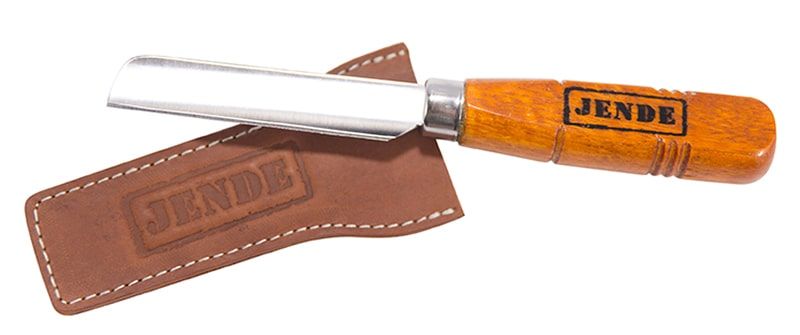
At Jende Industries, we provide professional sharpening services for Jende reed knives as well as virtually any make or model of reed knife used by oboe, bassoon, and clarinet players. Musicians and reed makers from around the world trust us to restore and maintain the precision edges required for detailed reed work.
The knife featured in this video is a well-used example that displays the typical signs of long-term use. Surface rust has developed from residual moisture left on the blade after reed adjustment sessions, while the darker patina is the result of exposure to natural oils and moisture from handling. Although the black or bluish patina may affect the appearance of the blade, it actually serves as a protective layer that helps shield the steel from further oxidation. More concerning are the orange or brown areas of active rust, which can eventually lead to pitting. When pitting occurs along the bevel or cutting edge, material is permanently lost, negatively affecting both performance and edge quality.
In this video, we demonstrate the proper process of cleaning, restoring, and sharpening a reed knife while preserving its original geometry. The focus is on removing corrosion, maintaining the blade’s condition, and restoring a razor-sharp edge suitable for the precise scraping and shaping required in reed making.
Special attention is given to sharpening techniques specifically suited for delicate reed knives. Maintaining the correct bevel angle and using controlled, consistent sharpening strokes are essential for achieving a refined edge without altering the knife’s intended geometry. Proper maintenance not only improves cutting performance but also extends the service life of the blade.
Throughout the demonstration, we emphasize the importance of routine blade care, corrosion prevention, and consistent sharpening practices. A well-maintained reed knife offers greater precision, control, and reliability, helping musicians produce more consistent and professional-quality reeds.
Whether you are new to reed making or an experienced oboe, bassoon, or clarinet player, the techniques shown in this video will help keep your reed knives performing at their best for years to come.
To refresh and recondition the blade, we used a scotchbrite-like wheel to remove the rust and create a more uniform surface on the blade, then followed it with a buffing with compound to polish the blade and tro “close off” the pores so water would not be able nestle in the small scratches. We then sharpened as usual using Chosera 600, 1K, 3K, and 5K stones, and personalised the burr on the Jende Folding steel. The blade is as good as new. Hopefully the reeds it makes will be as well!
Helpful Links:
Jende Reed Knife Sharpening Services
Jende Reed Knives
The Jende Book of Sharpening Double Hollow Ground Reed Knives