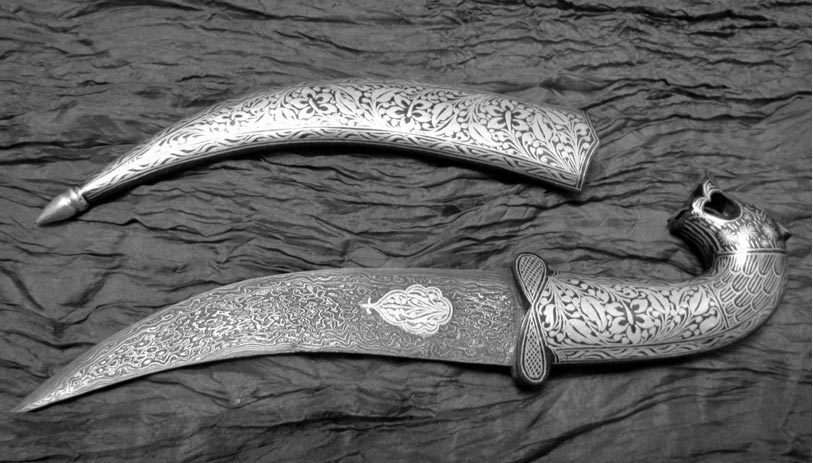
For centuries, true Damascus steel has fascinated blacksmiths, knife makers, historians, and collectors alike. Celebrated for its razor-sharp edge, exceptional toughness, flexibility, and mesmerizing flowing patterns, authentic Damascus steel earned a legendary reputation that continues to inspire modern bladesmiths.
Today, many knives are marketed as Damascus steel, but most are actually made using pattern-welded steel. While these blades feature beautiful layered designs and excellent cutting performance, they are fundamentally different from the original Damascus steel produced from Wootz steel.
What Is True Damascus Steel?
The term Damascus steel traditionally refers to blades forged from Wootz steel, a high-carbon crucible steel that originated in India and Sri Lanka more than 2,000 years ago. Steel ingots were exported to the Middle East, where skilled smiths transformed them into swords and knives renowned for their durability and cutting ability.
Unlike modern pattern-welded Damascus, authentic Wootz Damascus developed its distinctive surface pattern naturally through the internal structure of the steel itself. These flowing “watered” patterns were not created by stacking and folding different steels, but by carefully controlling the forging process and heat treatment.
Why Was the Secret Lost?
By the early 19th century, the knowledge required to manufacture genuine Wootz Damascus steel had largely disappeared. As experienced bladesmiths passed away, many of their techniques were never written down and were instead passed through apprenticeships. Political changes, shifting trade routes, and the depletion of historical ore sources further contributed to the disappearance of authentic production methods.
For over a century, scientists and knife makers attempted to uncover the secrets behind these remarkable blades. While they could imitate the appearance of Damascus steel, reproducing its unique microstructure and performance remained an enormous challenge.
The Breakthrough Research
A significant advancement came through the collaboration of master knifemaker Al Pendray and Professor J. D. Verhoeven, a metallurgical engineer. Together, they carefully examined surviving historical blades and conducted extensive experiments to understand what made authentic Wootz steel so unique.
Their research demonstrated that producing genuine Damascus patterns required much more than simply using high-carbon steel. They discovered that tiny amounts of trace elements—such as vanadium and other naturally occurring impurities found in historical iron ores—played an important role in developing the famous watered pattern during forging and heat treatment.
Just as important were the precise forging temperatures, thermal cycling, and controlled cooling techniques, all of which influenced the steel’s internal carbide structure and ultimately determined both its appearance and cutting performance.
Wootz Steel vs. Modern Pattern-Welded Damascus
Although both materials are commonly called Damascus, they are produced using entirely different methods.
Traditional Wootz Damascus
-
Produced from a single crucible steel ingot
-
Natural carbide patterns form during forging
-
Historic manufacturing process
-
Extremely rare today
Modern Pattern-Welded Damascus
-
Created by forge-welding multiple layers of different steels
-
Decorative patterns are produced by folding, twisting, or manipulating the layers
-
Widely available and highly regarded for both beauty and performance
-
Does not replicate the original Wootz microstructure
Both types of steel can produce outstanding knives, but only Wootz steel represents the historic material behind the legendary Damascus blades.
Why Does Wootz Steel Matter?
Beyond its beauty, Wootz steel represents one of history’s greatest achievements in metallurgy. Long before modern scientific instruments existed, ancient craftsmen learned how to control carbon content, heat, and forging techniques to produce blades with remarkable mechanical properties.
The study of Wootz steel has also helped modern metallurgists better understand carbide formation, heat treatment, and the influence of trace alloying elements on steel performance. These discoveries continue to influence today’s knife makers and materials researchers.
Learn More
If you’re interested in the history and science behind authentic Damascus steel, the excellent video from Mike Loades explores the research of Al Pendray and Professor J. D. Verhoeven in greater detail. It discusses how they recreated Wootz steel, the role of trace elements in forming the famous patterns, and the ongoing search for historical ore sources that may have been used by the original bladesmiths.
Final Thoughts
The mystery surrounding authentic Damascus steel captivated researchers for generations. Thanks to the pioneering work of Al Pendray and Professor J. D. Verhoeven, much of that mystery has finally been explained. While modern pattern-welded Damascus remains an outstanding choice for today’s knife enthusiasts, the story of true Wootz Damascus continues to be one of the most fascinating chapters in the history of bladesmithing.
Understanding the difference between authentic Wootz steel and modern Damascus not only deepens our appreciation of these remarkable blades, but also highlights the incredible craftsmanship and metallurgical knowledge achieved by ancient smiths centuries before modern technology.
While the process is not simple, nothing worth doing well is.